Scientific Name: Gleditsia triacanthos
Family: Fabaceae (the legume, bean, or pea family)
USDA Hardiness Zone: Zone 3-9
Size: 50-100 feet tall and wide; some specimens can be larger
Roots: All will have a fibrous component to them, but they also have a deep tap-root. Some honey locusts may have a number of thick, deep roots instead of a single tap root.
Growth Rate: Medium to fast Light: Prefers full sun
Moisture: Dry to wet soils. Can tolerate a very wide variety of soil moisture. Does not grow well on heavy clay or gravel soils where the taproot will have trouble establishing itself.
pH: Prefers neutral soils, but tolerates a wide range of soil conditions
Description: This native is regaining popularity in the silvopasture world due to its many uses, especially for ruminant livestock. It fixes nitrogen in the soil, grows pretty fast, has edible pods commonly used as livestock fodder, creates high quality lumber which resists rot, and can be used in barren, droughty, or polluted soils.
Main Silvopasture Uses:
• Animal fodder. In a silvopasture, this is our #1 use. Pods are high in sugar, which is our main objective. Pods also contain solid protein, but most of that protein is locked away in hard-to-digest seeds. Primarily feed for ruminants, though pigs will gladly eat them as well. Drops pods late fall through winter, at a time when forages are dormant and livestock need access to more feed energy to put them in good condition before winter. Leaf fodder is also useful for ruminants and high in protein.
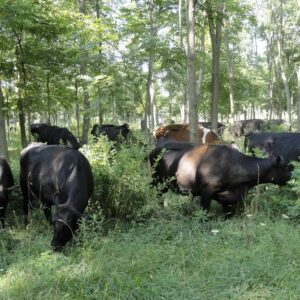
• Shade. Honey locust has one of the best shade profiles of any pasture species, which is another main reason we like it for silvopasture. The shade is very dappled, allowing a lot of light to come through the canopy to the forages beneath. See Greg Judy discuss honey locust shade during a drought here. It also grows to be a fairly tall tree and prunes up easily, thus allowing the shade cast from the canopy to move a lot throughout the day.
Other Uses:
- Lumber. Creates a high quality, hard, durable wood used in construction, furniture. Also fairly rot resistant and can be used for fence posts, but note that it is not as rot resistant as black locust. Coppices well.
- Nitrogen fixation. Known to fix nitrogen, though not as heavily as other legumes like black locust.
- Sweet Pods. The mature pods have a sweet pulp, which can be made into sugar. Previous generations have researched the use of honey locust as a perennial feedstock for biofuels.
- General insect (especially bees) nectar plant. (Note: black locust is more important for honey production than honey locust due to its abundant flowers. The ‘honey’ in the name “honey locust” refers to the sweet pulp inside its pods, not to the production of honey by bees.)
- Wildlife Food Source. Especially attractive to deer (just as to livestock) as a high-energy feed in winter.
Special Considerations:
• The thorns on this tree can be quite large! This is a major issue, as anyone living in an area where wild honey locusts thrive will know very well. This will require careful genetic selection of trees to create trees that will reliably, consistently be thornless, and whose offspring will also be reliably thornless. Be aware though that even if you order seedlings that are supposed to be thornless, oftentimes nurseries will still send trees with thorns. This is because while the trees those seeds were collected from may have been thornless, the resulting seedlings won’t necessarily be thornless. And even if thornless as a little 24” seedling, they may still develop thorns as they grow. TFG is working on selecting and clonally propagating thornless varieties. Grafted trees will be thornless, though they may still produce thorny seedlings. For more details on the work of TFG to select for and propagate high-quality, thornless trees, see this link.
Some people consider this tree to be invasive to certain areas of the US, so be careful if you are introducing it outside of its natural range (though that natural range is very large in the Eastern US). What’s definitely true is that in the right context, honey locust can spread aggressively, especially if there’s a lot of thorny trees coming up that withstand browse. This makes it all the more important to carefully select for thornless traits when choosing stock.
Honey locust seedlings are generally either male or female (there are some instances where there are male and female flowers on the same tree). This is another reason for clonal propagation, to ensure all trees planted are female and contribute pods. It may be that without a male tree nearby, trees would yield pods without seed, which would be ideal, since the seed has little value since it’s mostly indigestible, and a lack of seeds would mean no new seedlings sprouting in unwanted places. There is a report that some trees produce seeds without the strong protective coating, which are hence more digestible, which may be an interesting factor to select for. All of this needs more research.
Selections seem to have masting tendencies, and produce high in some years and low or not at all in other years. Thankfully, it seems that different varieties don’t sync up so that planting a bunch of varieties (or seedlings) can provide consistent yield.