I previously wrote that when you spread the cost of tree establishment out over 20 years, the cost per pound of feed that they displace is amazing. For most tree crops we’re looking at feed costs significantly less than 10¢, and in some cases closer to 1¢ per pound of grain feed that’s offset. For reference, conventional feed prices for pigs are around 15¢ per pound, and organic prices are above 40¢. The prices go higher yet if you want feed without corn or without soy. Yet that’s exactly what these trees produce: organic, corn-free, soy-free feed, all dropped year after year with very little labor cost.
I’ll be honest and say I did the math on those again and again, thinking that I must be wrong about something. I’d always figured that tree crops could beat out organic grains, but to think of tree crops beating even conventional grain, and some costing 90% less than conventional grain, the gold standard of low cost!? That sounded plain impossible. It would be nothing short of revolutionary, and it’s just sitting out there in the open, not protected by patents or a secret society, just waiting for someone to run with.
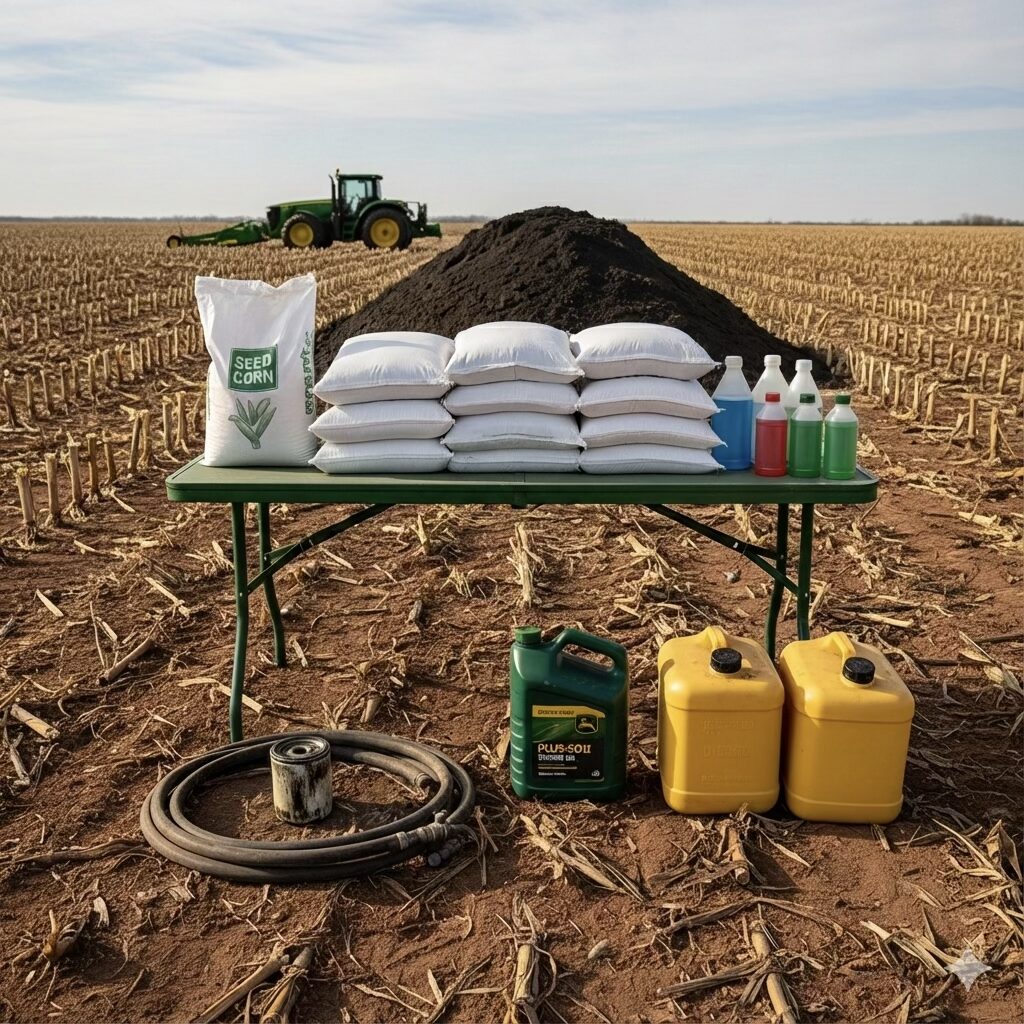
The way this finally sunk in and made intrinsic sense is when I decided to look up what it takes to grow an acre of corn. According to the National Corn Growers Association, in 2025 it cost, on average, $897 to grow an acre of corn. This image gives you an idea of what those inputs look like. We’re talking about $100 worth of seed, several hundred dollars of fertilizer, another hundred dollars of chemicals (herbicides, pesticide and fungicides), a hundred dollars of machinery cost and depreciation and gallons of diesel fuel. Oh, and the soil loss is astounding, with rough estimates that without no-till, you’re losing about a pound of topsoil with every single pound of corn produced. I don’t think I need to tell you that’s not a good thing.
Interestingly, we can plant an acre of top-notch, high-yielding mulberry trees for about that same cost. Although initial costs are similar, corn and mulberry crops then split into two very different trajectories. While those mulberry trees won’t give you any substantial yield for several years, once they do, they will yield heavily, and for free, for a century or more. The corn will yield you a massive crop the very same year, but then you’ll need to plant it again the next year, and the next year, and the next. Even though the mulberries require an up-front investment and several years without revenue, they eventually catch up, and then far, far exceed the corn. It just takes some patience, and figuring out how to make the cash flow work.
This is, of course, not the same with all trees. Mulberries will probably give the highest return on investment, yielding quickly and abundantly. Oaks, on the other hand, will take many years longer to start yielding, and will not yield as abundantly or regularly once they do. There is a role for them on silvopasture operations, but it’s a smaller one requiring more patience, and it’s the place where outside cost-share for ecosystem services makes the most sense.
When framed from this perspective, it’s pretty clear why planting trees for livestock feed makes so much sense as a long-term strategy. It’s a relatively low one-time investment, and with the right species, right genetics and right care, your returns on that investment can be tremendous. This is the pathway forward to revolutionizing the way livestock are raised, at scale.